

Kailash Calling –
A Tibet Motorcycle Tour to Mount Kailash, Everest Base Camp and Guge
Not every expedition starts in a boardroom or with a long-term business plan. The original idea for this Tibet motorcycle expedition was born during one of our annual Ride & Connect gatherings, where riders, travellers and our team spend an evening exchanging stories, future ideas and expedition dreams. Somewhere between maps, photographs and conversations about remote places in the Himalaya, the idea emerged to create a motorcycle journey across Tibet all the way to Mount Kailash.
Only one year later, the first Kailash Calling motorcycle tour became reality.
And not in just any year. This particular ride took place during the Tibetan Year of the Horse — a special year in Tibetan Buddhism that occurs only once every twelve years and is considered especially auspicious for visiting Mount Kailash. From Lhasa and Everest Base Camp to the sacred shores of Lake Manasarovar and the ancient Kingdom of Guge, Kailash Calling would become far more than simply another motorcycle tour through Tibet.
Lhasa – The Gateway to Tibet
Every journey into Western Tibet begins in Lhasa.
Lhasa possesses a certain weight and fascination unlike almost anywhere else in the Himalaya. Even after many years of operating motorcycle tours across the Tibetan Plateau, there remains a feeling that entering Tibet means stepping into a world that moves according to its own rhythm — culturally, spiritually and geographically.
Perched at more than 3,600 metres above sea level, Tibet’s ancient capital is far more than simply the starting point of a motorcycle tour. For many riders, arriving in Lhasa marks the moment when years of dreaming about Tibet finally become reality.
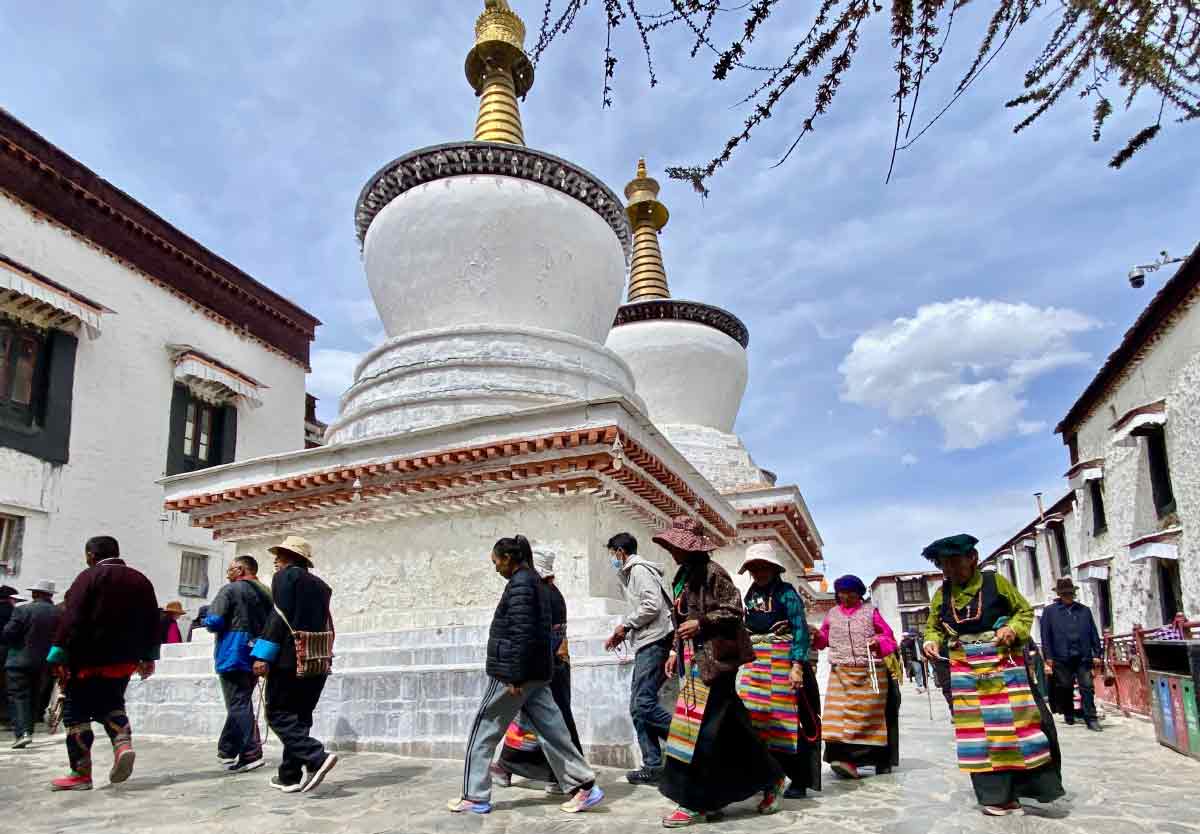
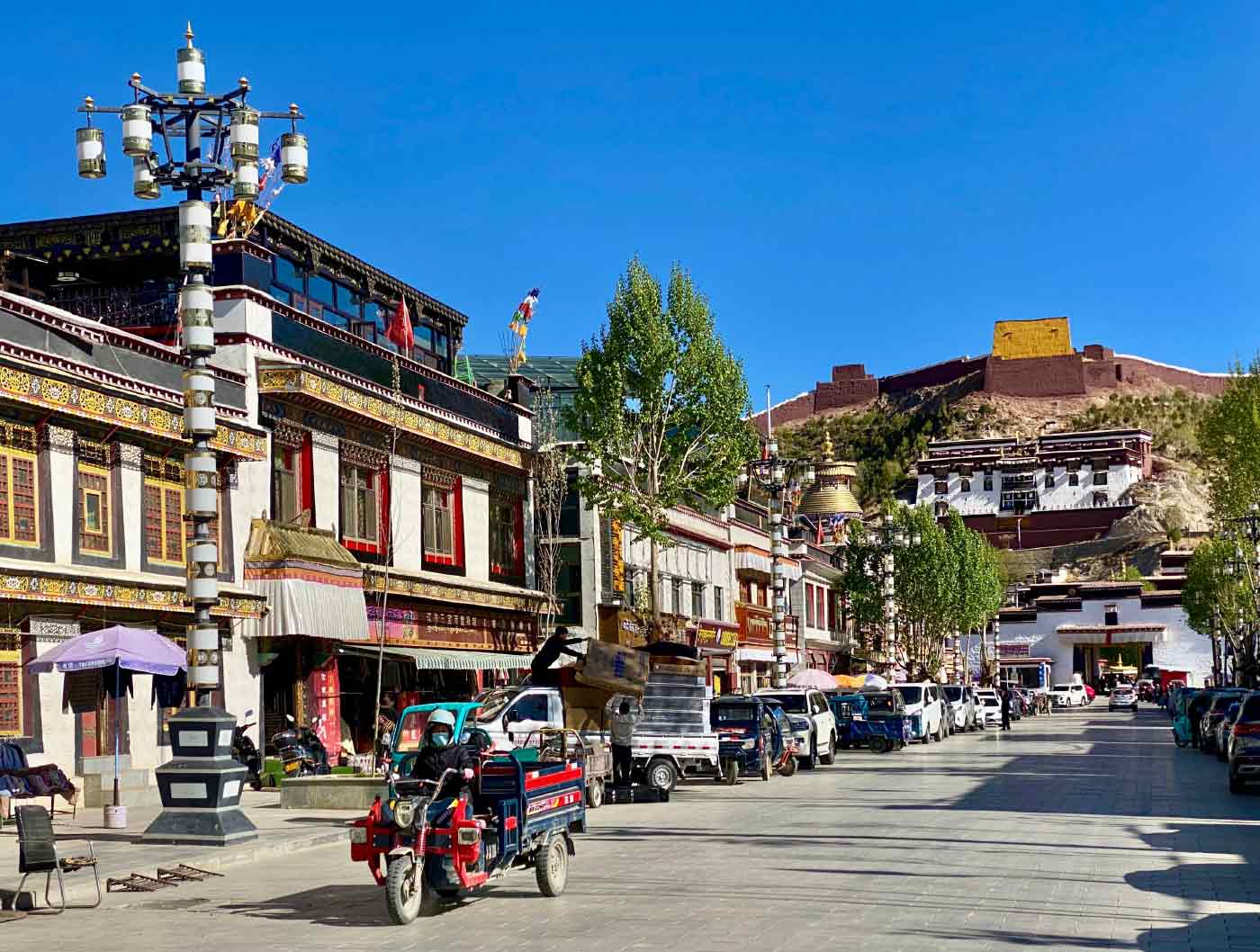
Towering above the city stands the magnificent Potala Palace, once home to the Dalai Lamas and still one of the most iconic landmarks anywhere in Asia. Around Jokhang Temple, pilgrims slowly make their way along the Barkhor circuit, turning prayer wheels as the scent of burning incense and butter lamps drifts through the narrow streets of the old city.
For first-time visitors, Lhasa can feel unlike anywhere else in the Himalaya. Ancient traditions remain deeply woven into modern everyday life, and the city possesses a unique atmosphere that is difficult to describe until experienced firsthand.
The first days are spent exploring some of Tibet’s most important cultural and religious landmarks. At Sera Monastery, monks still gather for their famous afternoon debates, challenging one another through animated discussion, ritualised gestures and centuries-old Buddhist philosophy. Watching these exchanges unfold offers a fascinating glimpse into traditions that have remained alive for generations.
At the same time, the days in Lhasa provide an opportunity to adjust gradually to the altitude before the route climbs higher onto the Tibetan Plateau. With Everest Base Camp, Western Tibet and Mount Kailash still ahead, there is no need to rush.
Of course, travelling through Tibet also involves a certain amount of preparation. Before the motorcycles can leave the city, riders complete the formalities required for the temporary Chinese driving licence issued in Lhasa. Like many things in Tibet, the process follows its own rhythm. Yet once the paperwork is complete and the motorcycles stand ready outside the hotel, thoughts quickly turn westward.
By the time the motorcycles finally leave Lhasa and turn west toward the Tibetan Plateau, most riders already realise that this journey is not going to feel like an ordinary motorcycle tour.
And beyond Lhasa, the journey is only just beginning.
Into the Heart of Tibet
The first days on the motorcycles are deceptive. The roads are smooth, the skies often impossibly blue and the landscapes almost unreal in their scale. But very quickly, the altitude starts making itself felt.
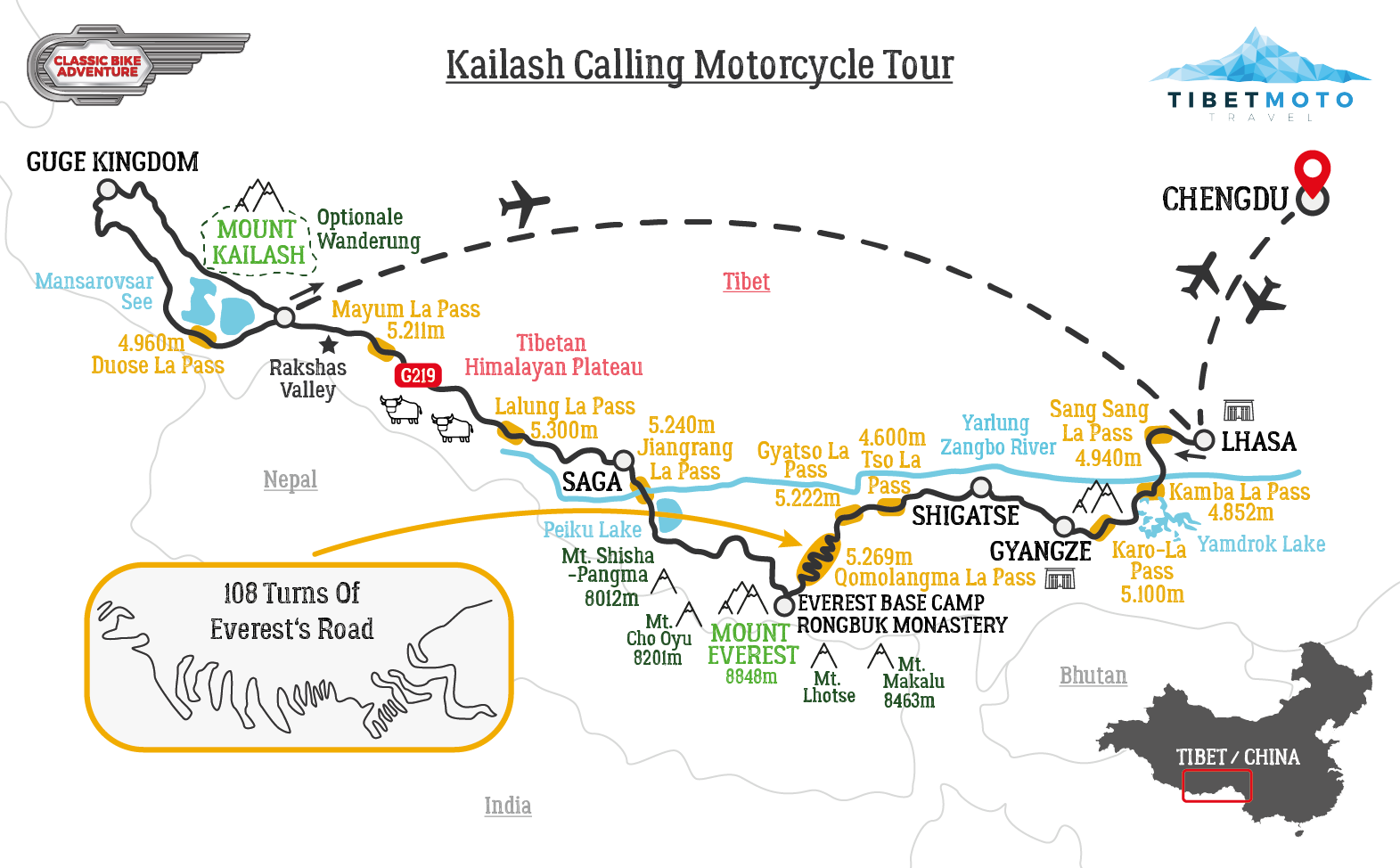
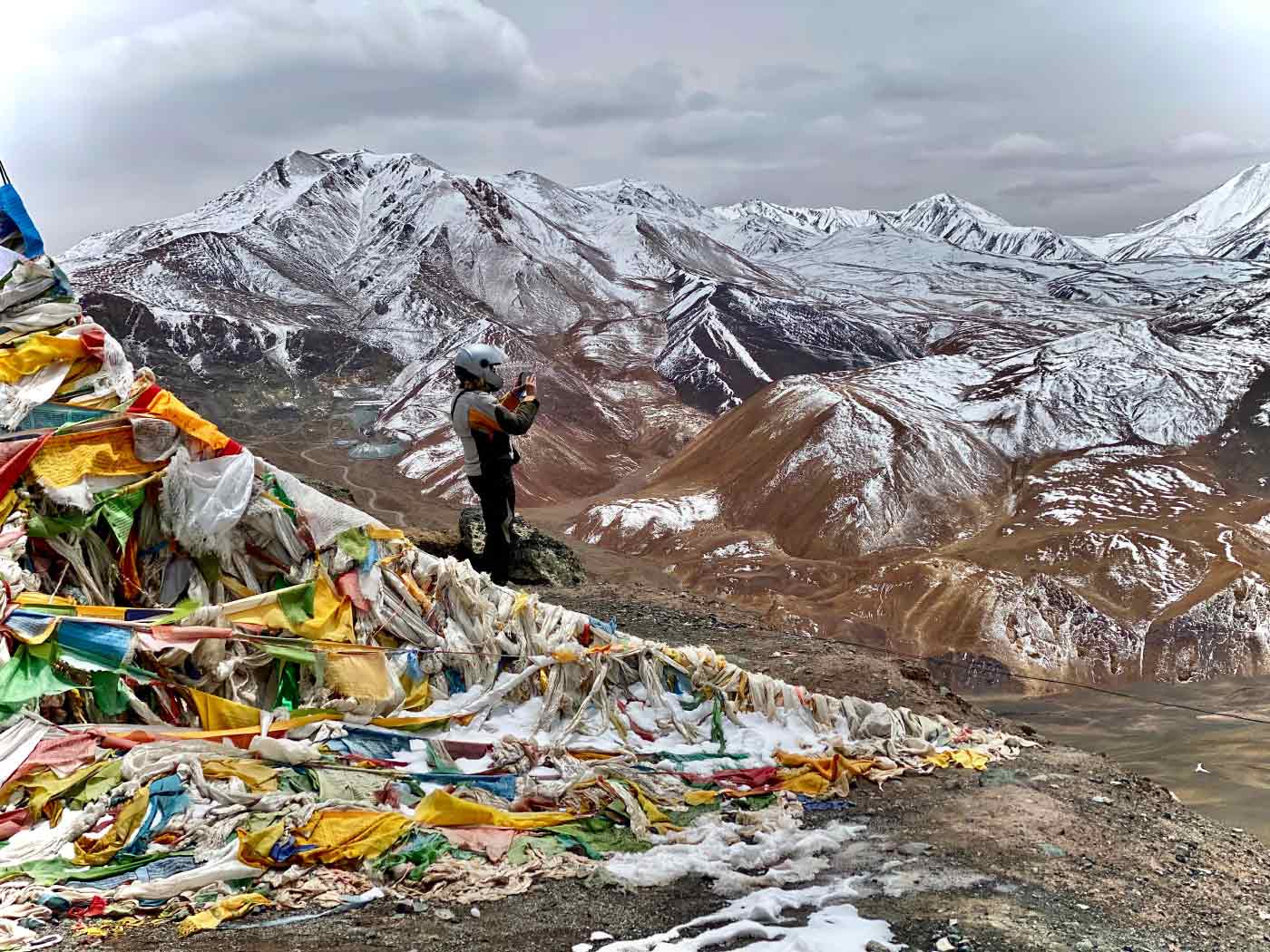
The route first crosses Kamba La Pass at nearly 4,900 metres, where the turquoise waters of Yamdrok Lake suddenly appear far below the road. Few moments on a Tibet motorcycle tour prepare riders for that first view. Prayer flags move violently in the wind while the road snakes down towards one of Tibet’s most sacred lakes.
According to local belief, the lake possesses spiritual powers and can cleanse sins. In theory, riders wanting a complete spiritual reset are welcome to jump into the ice-cold water — although most wisely decide that simply admiring the lake from a distance is sufficient.
From there, the journey continues climbing even higher towards the Karola Glacier. At over 5,000 metres, the landscape begins to change noticeably. The air becomes thinner, the wind colder, and the landscape increasingly vast and empty. A wall of ice hangs directly above the road – a remnant of a once much larger glacier.
A cup of hot tea below the glacier, and the tour continues – further west lies Gyantse with its famous Palcho Monastery and Kumbum Stupa — the largest pagoda of Tibet. And at this point, the journey has still only just begun.
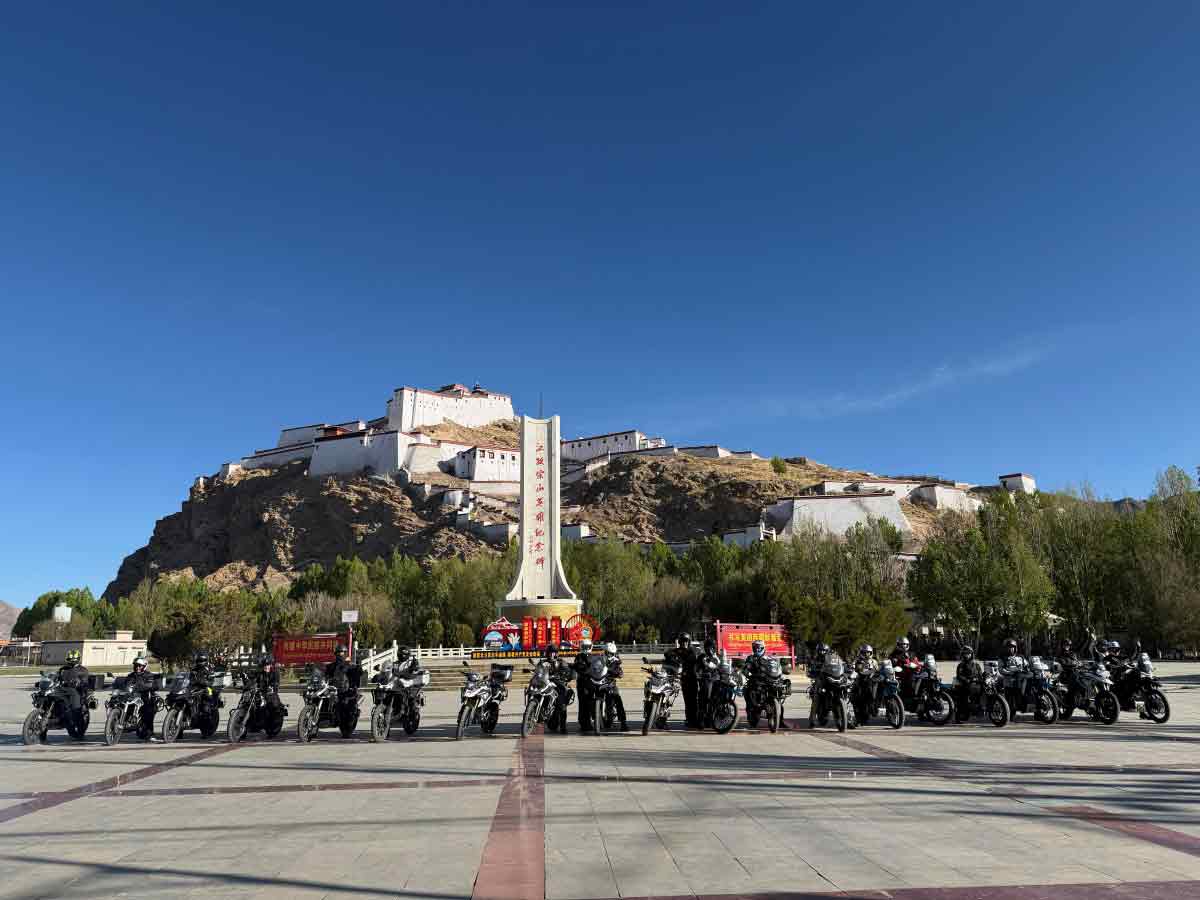
The Ride to Mount Everest Base Camp
One of the defining moments of this Tibet motorcycle tour is the ride to Mount Everest Base Camp from the Tibetan side. The closer the route moves toward Everest, the more dramatic the landscape becomes. Beyond Tingri, the open plains of Tibet gradually give way to a world of towering peaks, vast skies and seemingly endless distances. The road climbs higher and higher until, suddenly, the Himalaya reveal themselves in all their scale.
Soon the route reaches one of the most famous stretches of road in Tibet: the legendary 108 curves descending toward Everest Base Camp. Far below, the switchbacks snake across the mountainside while some of the highest peaks on Earth begin to emerge along the horizon. Mount Everest dominates the horizon, but it is far from the only giant rising above the Himalaya. Along the skyline stand Cho Oyu, Lhotse and Shishapangma, while countless other 7,000- and 8,000-metre peaks disappear into the distance. Few places on Earth offer such a concentration of the world’s highest mountains. Standing here, it becomes easy to understand why travellers, climbers and explorers have been drawn to this region for generations. The scale of the landscape is difficult to comprehend. Every direction seems filled with mountains, distance and sky.
Eventually, the road reaches the final settlement before Mount Everest Base Camp. This is where the motorcycles have to stay behind. To protect the fragile high-altitude environment around Everest, private vehicles are no longer permitted to continue all the way to Rongbuk Monastery and Everest Base Camp. After days spent crossing Tibet by motorcycle, it feels slightly strange to leave the bikes standing on the plateau while the journey continues by shuttle bus across the final windswept kilometres. Yet the moment the north face of Mount Everest begins to emerge in full scale, nobody thinks much about the motorcycles anymore.
For many riders, seeing Everest from the Tibetan side is a dream years in the making and one of those rare travel moments that fully lives up to expectations. It is difficult to stand beneath the highest mountain on Earth and not feel at least a little humbled by the sheer scale of the Himalaya.
Across the Western Tibetan Plateau
After Everest Base Camp, the expedition continues deeper into western Tibet.
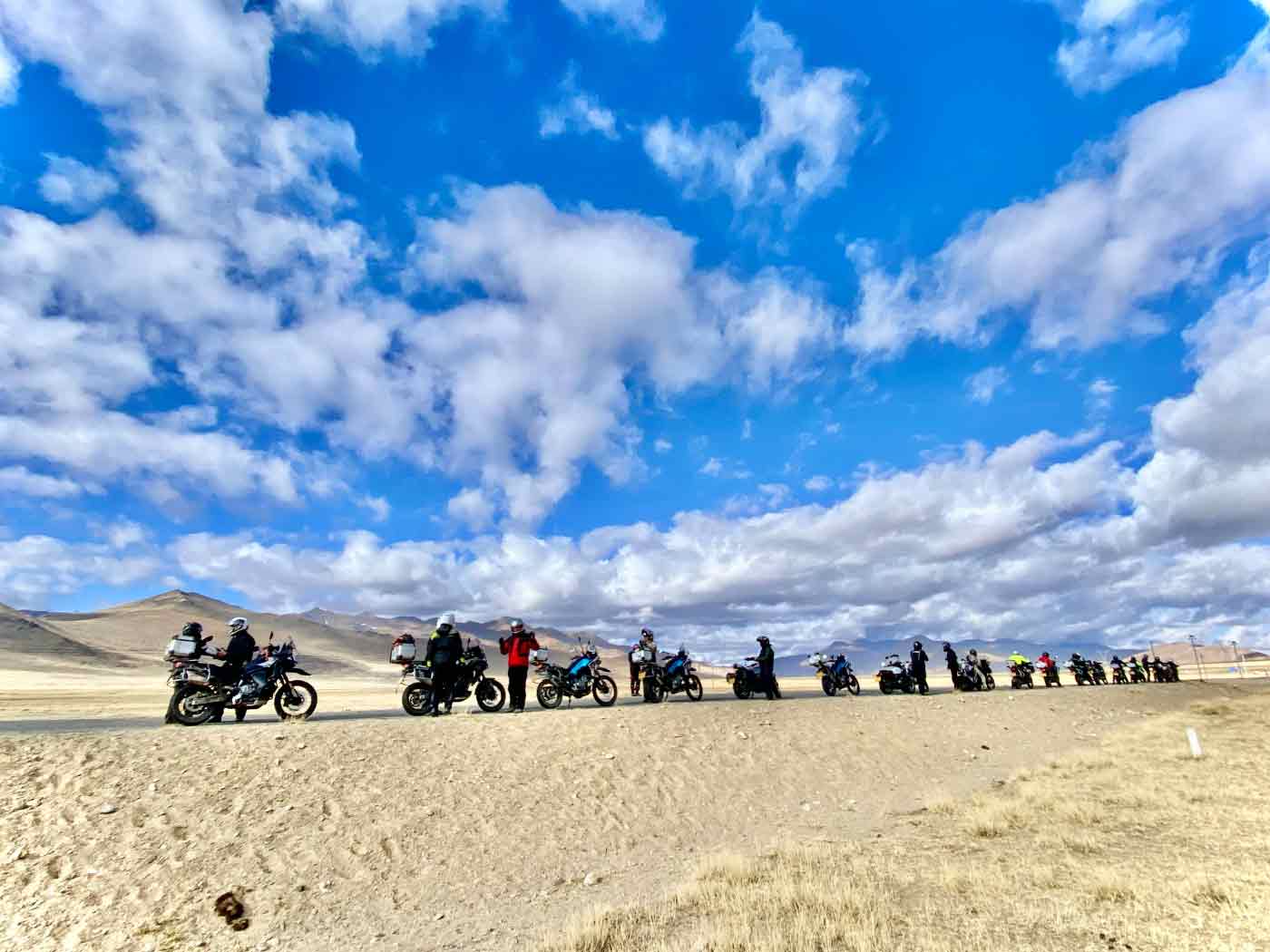
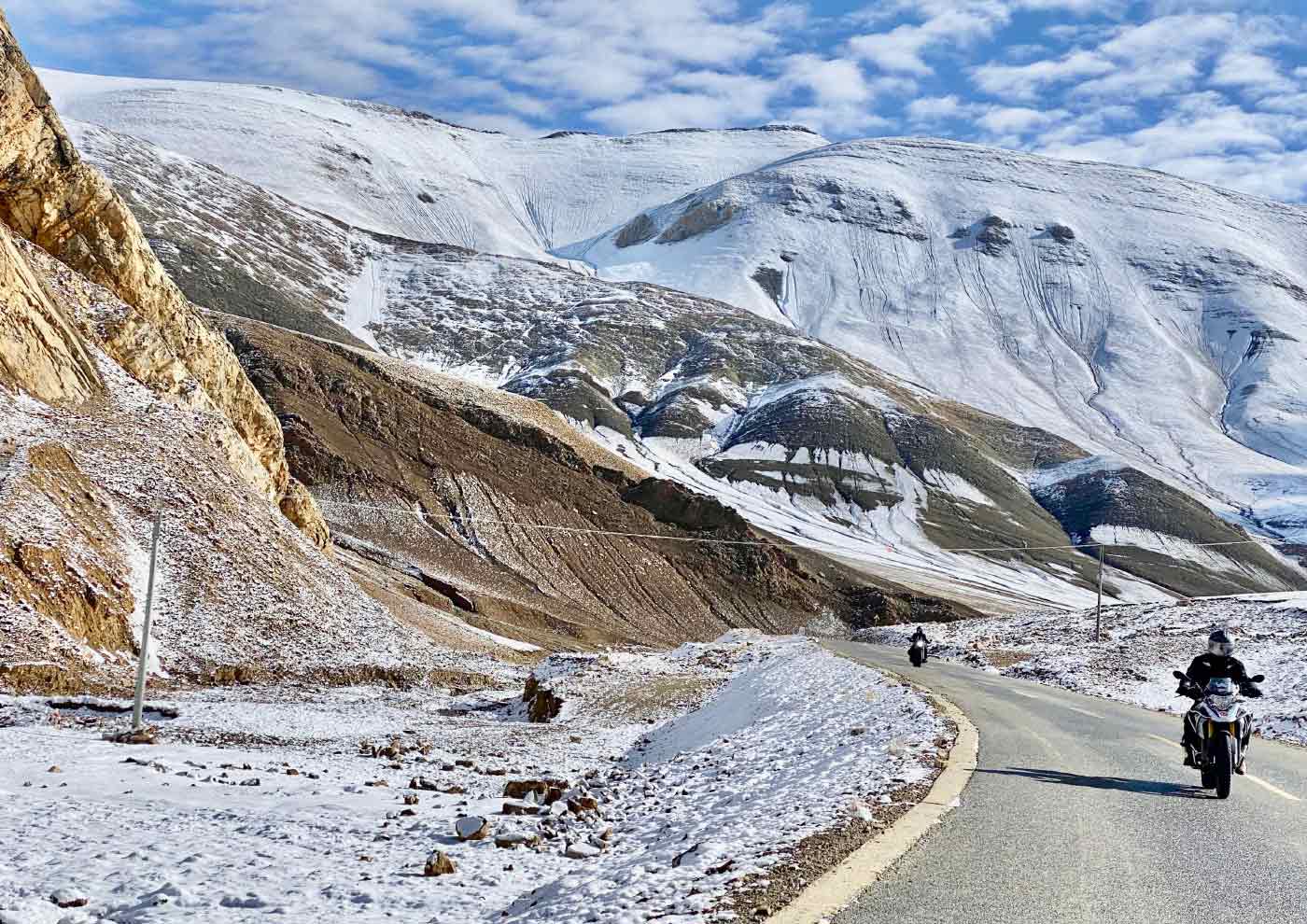
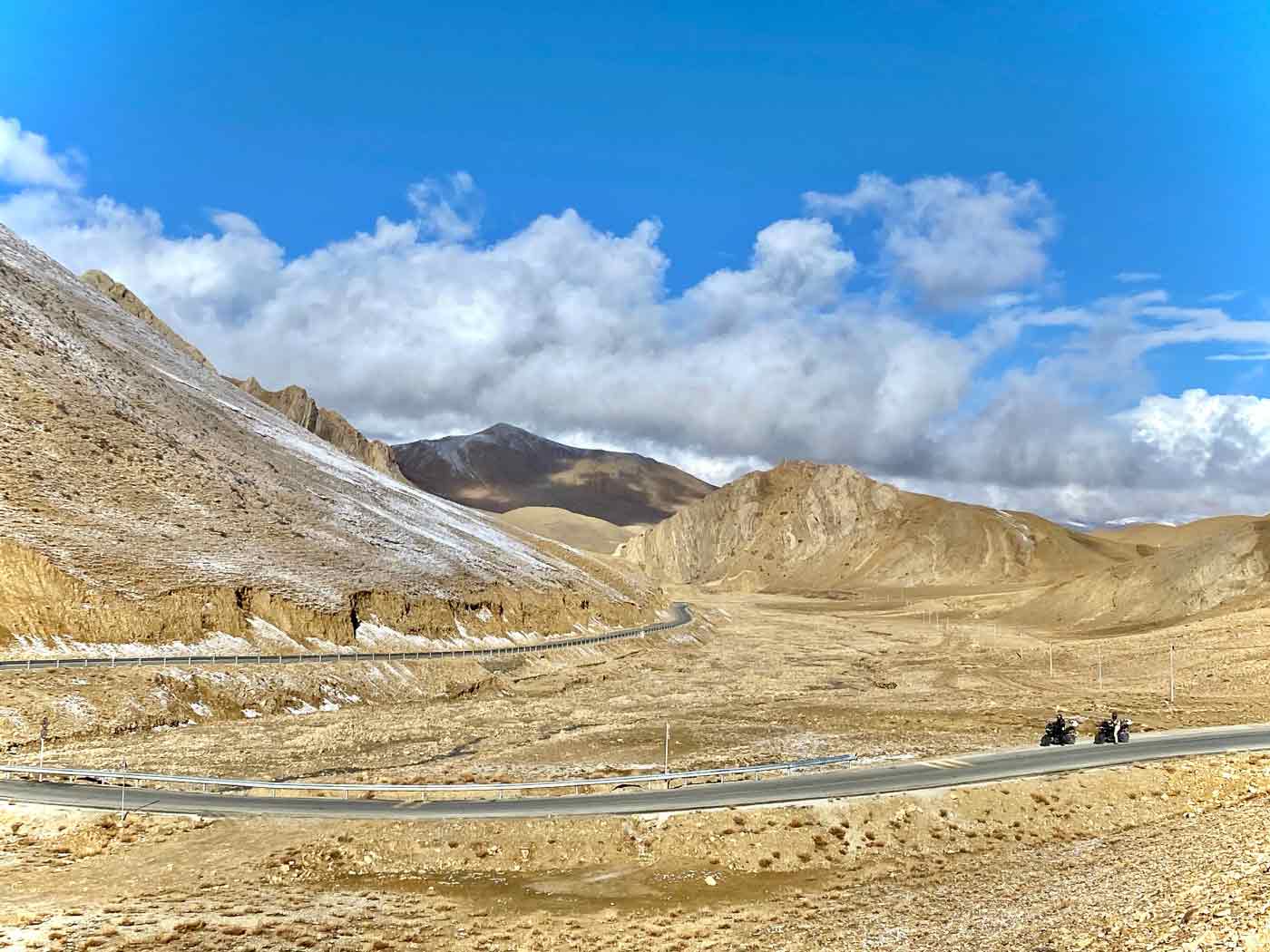
This part of the journey represents the core of any true Western Tibet motorcycle expedition, where distance, altitude and isolation define the riding experience. The landscapes become increasingly vast, empty and barren. Roads stretch endlessly across the plateau, settlements become smaller and farther apart, and the feeling of remoteness grows stronger with every hour spent on the bike.
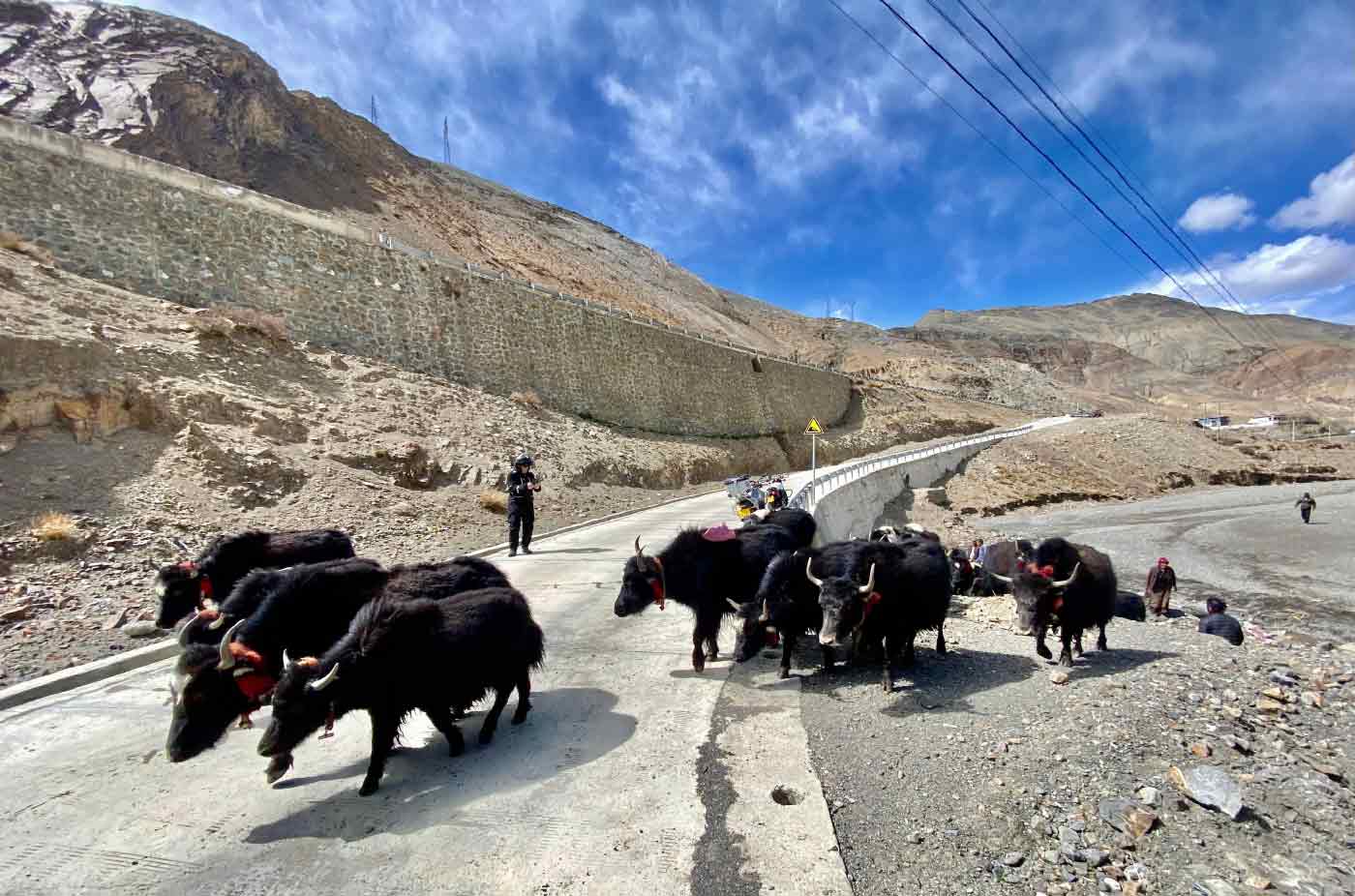
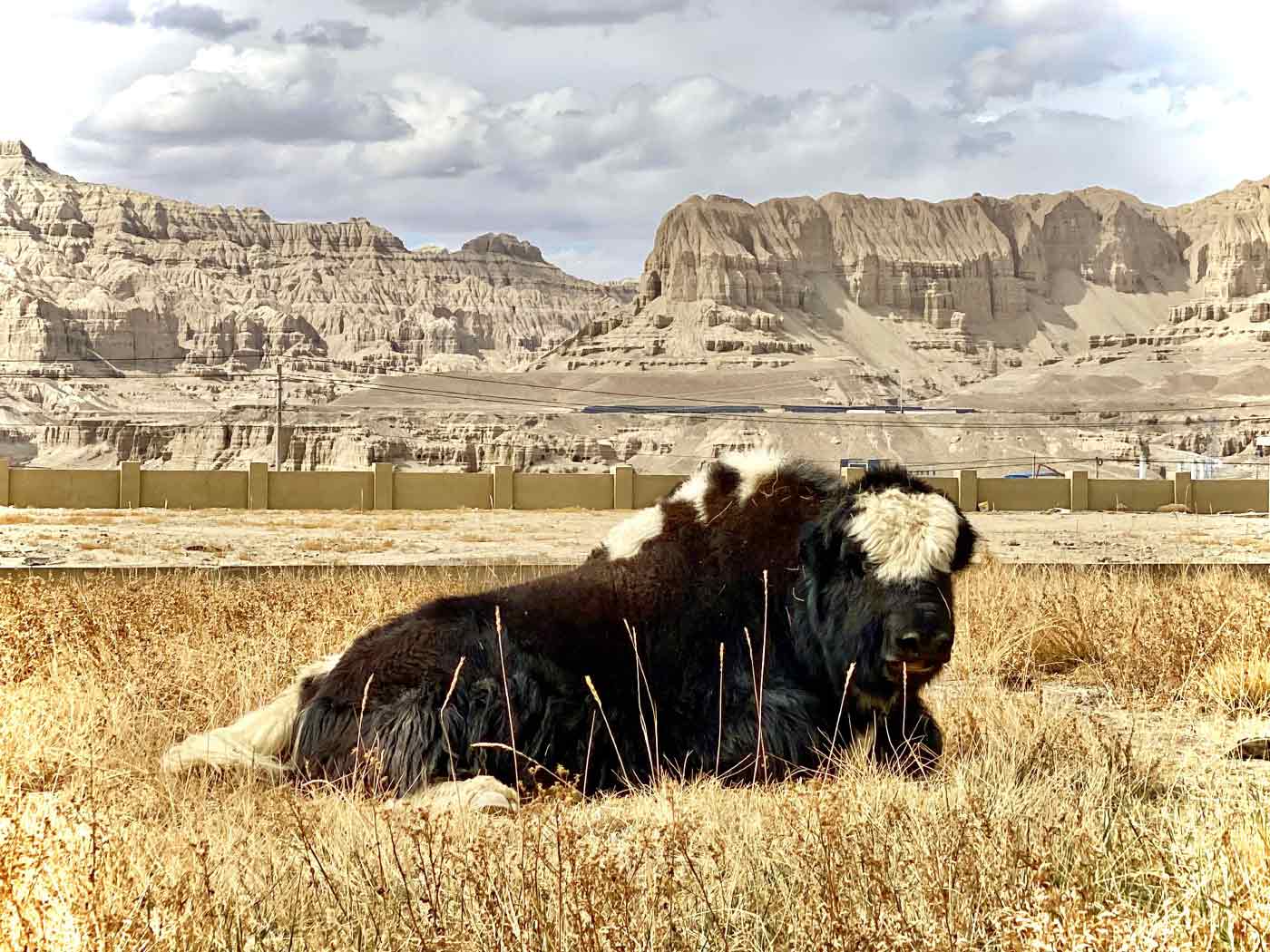
In the distance, grazing yaks dot the plateau, and occasionally small groups of kyang — the wild Tibetan horses of the high plateau — suddenly break into a gallop as the sound of the approaching motorcycles rolls across the open landscape.
Infrastructure in western Tibet remains extremely limited in many regions. Distances are enormous, weather conditions can shift quickly, and the plateau itself can feel both beautiful and unforgiving at the same time. But this is also exactly what makes western Tibet such a unique region to experience by motorcycle.
Mount Kailash & Lake Manasarovar
Beyond Saga, the distances grow even greater. Roads stretch across vast open landscapes where settlements become increasingly rare, and the feeling of remoteness deepens with every passing hour. Yaks graze across the grasslands, while small groups of kyang — the wild horses of the Tibetan Plateau — occasionally break into a gallop as the sound of approaching motorcycles rolls across the open landscape.
Western Tibet remains one of the least populated and most isolated regions in the Himalaya. Distances are immense, weather conditions can change quickly, and the landscape often feels as wild today as it must have felt generations ago. And then, eventually, the sacred landscapes surrounding Mount Kailash begin to appear on the horizon.
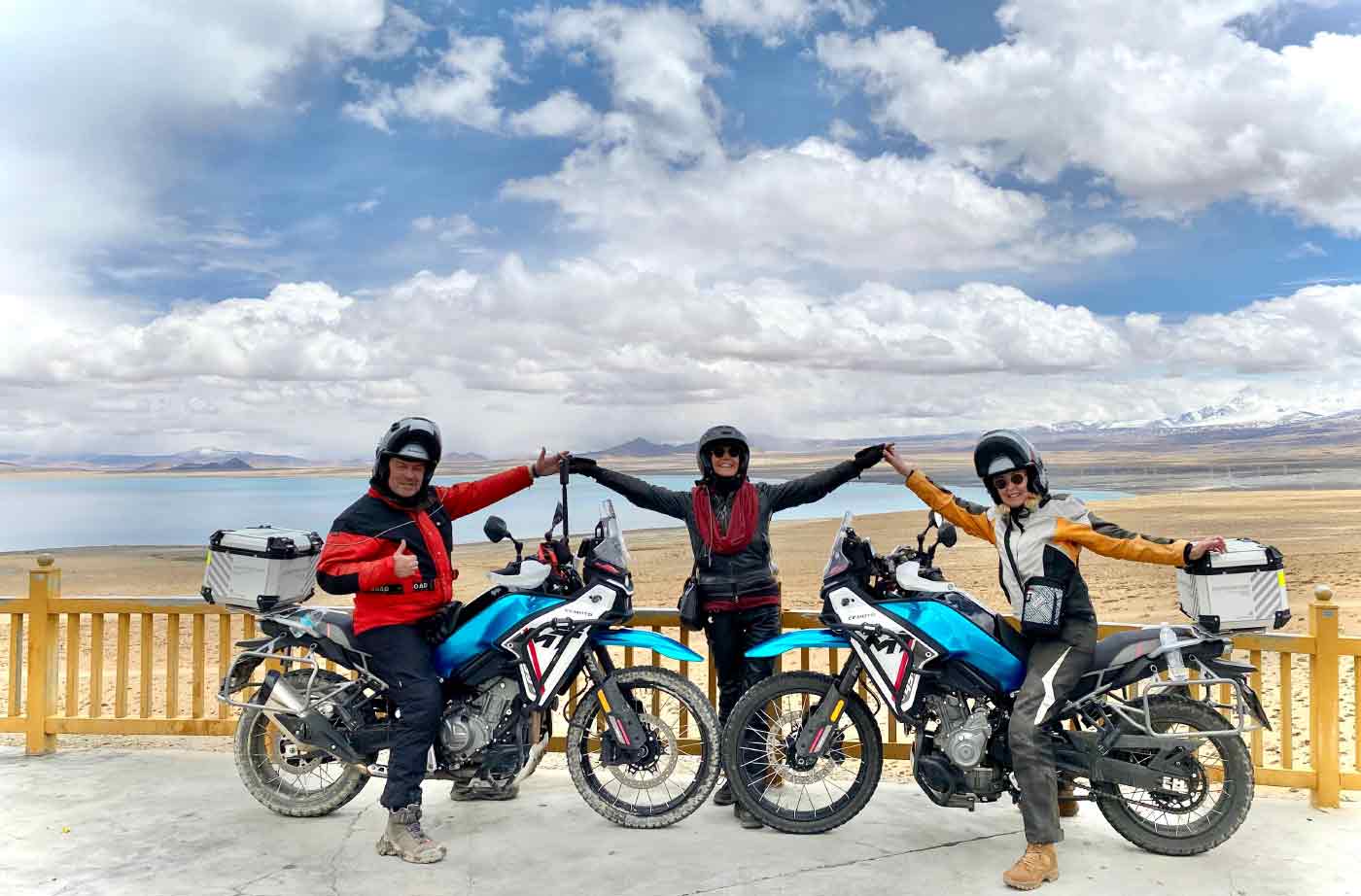
Before reaching Darchen, the route follows the shores of Lake Manasarovar, one of the holiest lakes in Asia and a place that has attracted pilgrims for centuries. Here the motorcycles can be ridden almost to the water’s edge. The deep turquoise waters stretch toward the horizon, while beyond the lake rises the snow-covered Gurla Mandhata range along the border between Tibet and Nepal.
It is one of those places where anyone instinctively stops, switch off their engines and simply take in the view for a while. Remote monasteries and hermitages appear along sections of the shoreline, adding to the feeling that this is a landscape shaped as much by spirituality as by geography.
The immense openness of the plateau, the constantly changing light and the distant presence of Mount Kailash create an atmosphere unlike anywhere else in Tibet.
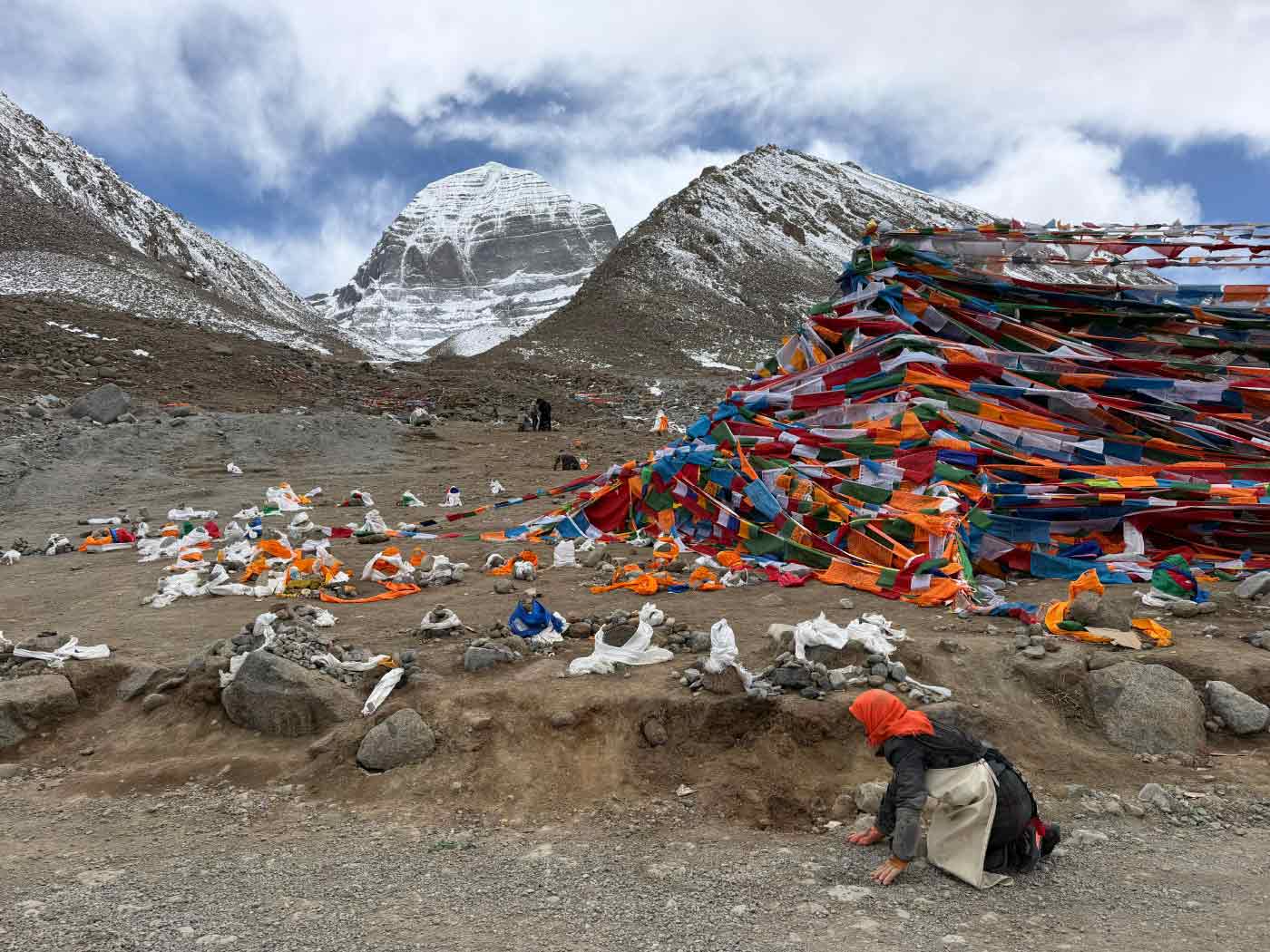
Not far from the lake lies Darchen, the small settlement at the foot of Mount Kailash and the starting point of the sacred Kailash Kora. For Tibetan Buddhists, Hindus, Jains and followers of the ancient Bön religion, Mount Kailash is among the holiest mountains on Earth. In Tibetan Buddhism it is regarded as the earthly manifestation of Mount Meru, the mythical centre of the universe. In Hindu tradition it is revered as the home of Lord Shiva.
Even within Darchen itself, signs of pilgrimage are everywhere. Pilgrims arrive from across Tibet and far beyond, some after weeks of travel. Others perform full-body prostrations, throwing themselves to the ground and repeating the movement thousands of times on their journey around the sacred mountain. Once witnessed firsthand, the atmosphere surrounding Mount Kailash feels very different from anywhere else in the Himalaya.
Even those not continuing on the full Kailash Kora often choose to walk a short section of the pilgrimage route beyond Darchen. Within a surprisingly short distance, the town disappears behind you and the sacred mountain begins to dominate the landscape in a way that photographs can never fully capture.
Yet the journey does not end here.
The Lost Kingdom of Guge
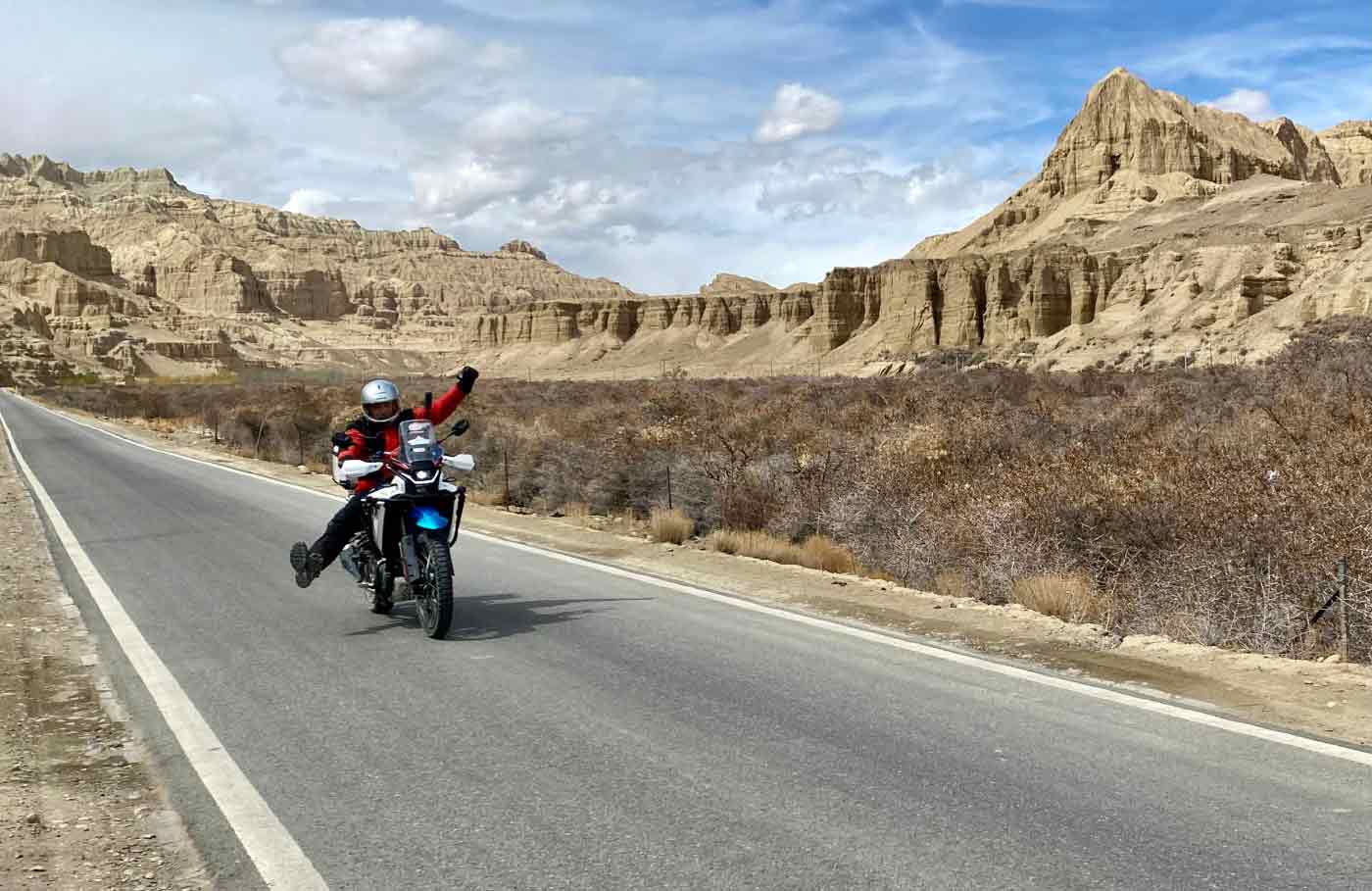
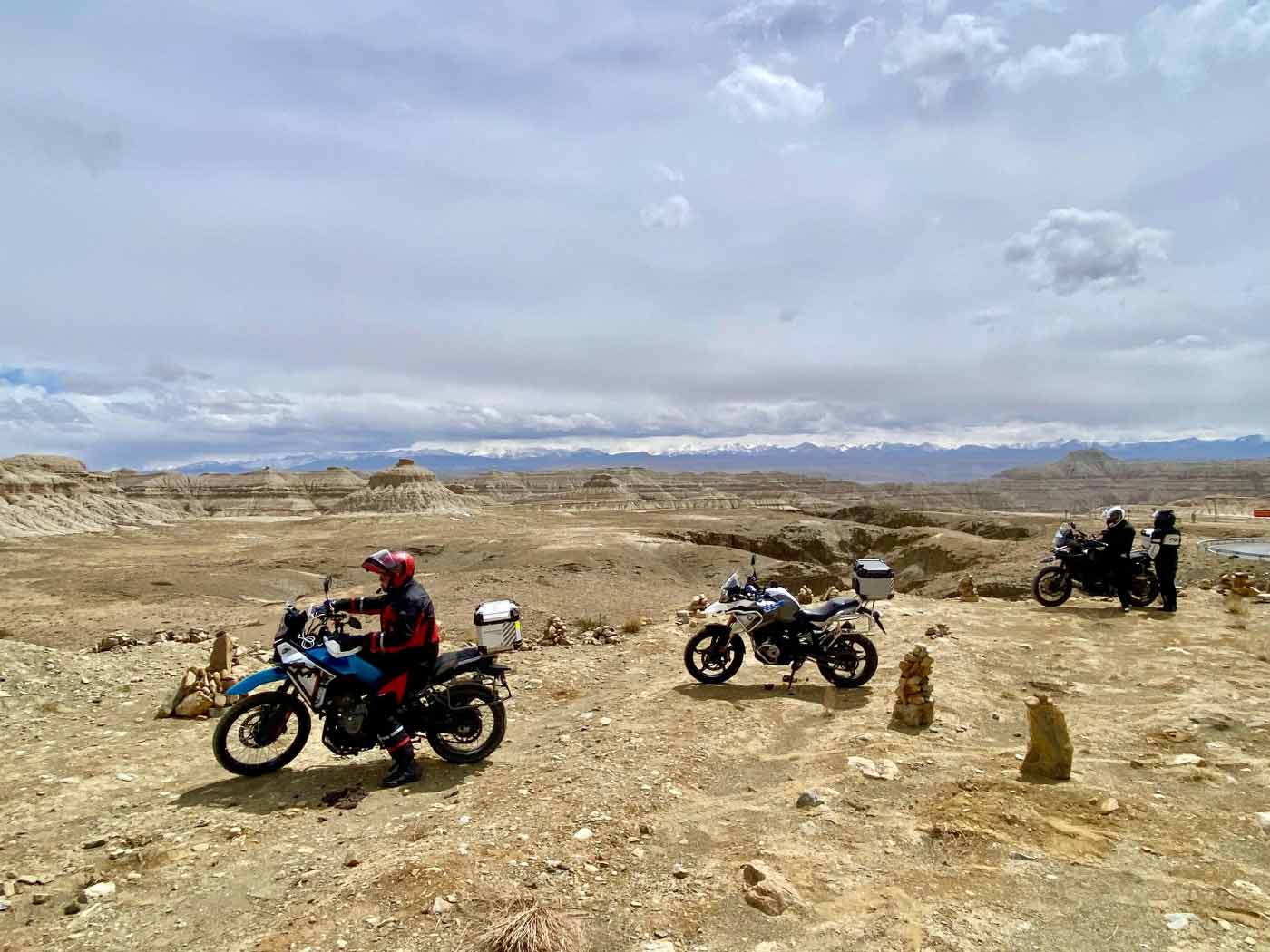
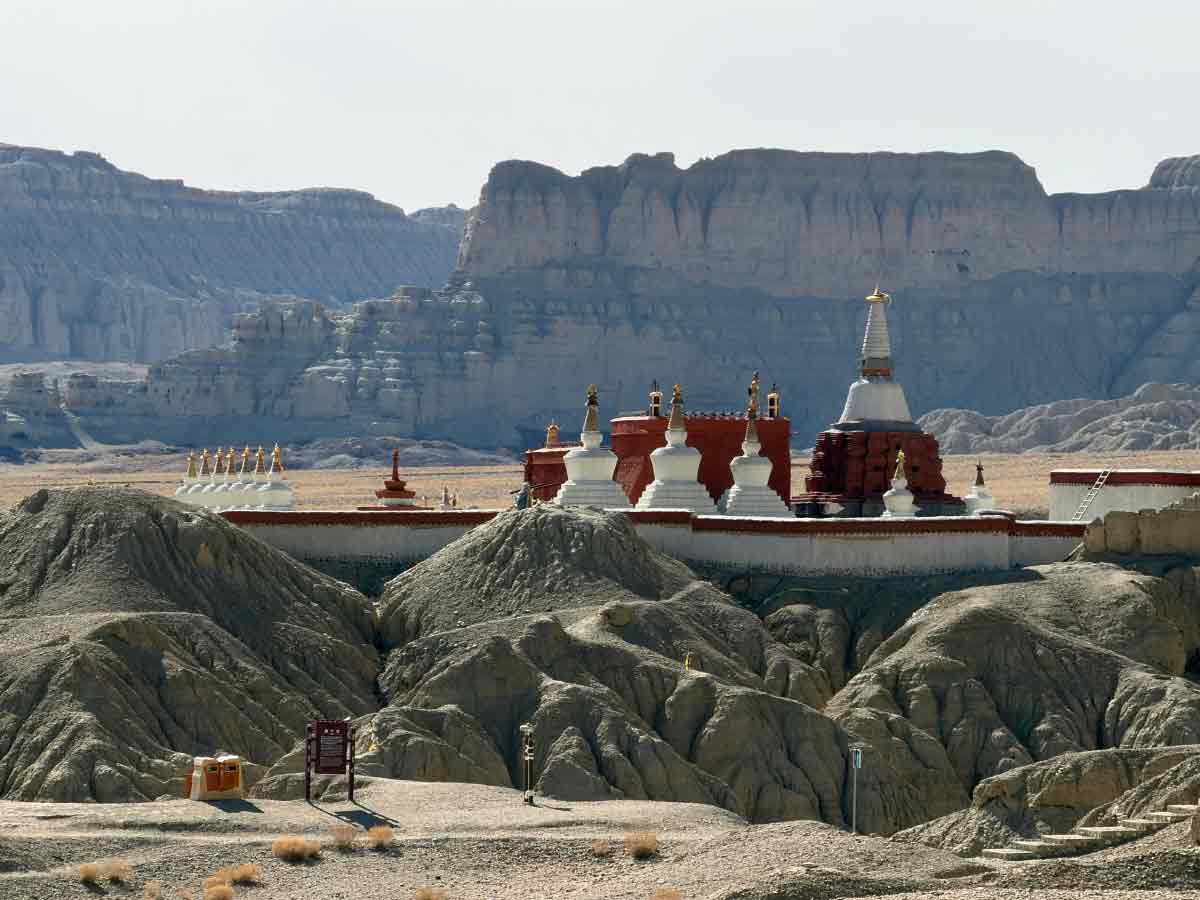
From Darchen, the route continues west toward Zanda and Tsaparang, entering one of the most fascinating and least visited regions of Tibet. Almost without warning, the landscape changes completely. The open plateau gives way to a surreal world of eroded sandstone formations, deep canyons and towering cliffs sculpted by wind and time. Ancient cave dwellings appear high above the valleys, while the remains of monasteries and fortresses seem to emerge directly from the mountains themselves.
Hidden near the borders of Nepal and India lie the ruins of the ancient Kingdom of Guge, one of the great lost civilizations of the Himalaya. Historians continue to debate exactly what happened here. Once a flourishing kingdom, Guge disappeared from history during the 17th century, leaving behind abandoned citadels, temples and countless unanswered questions.
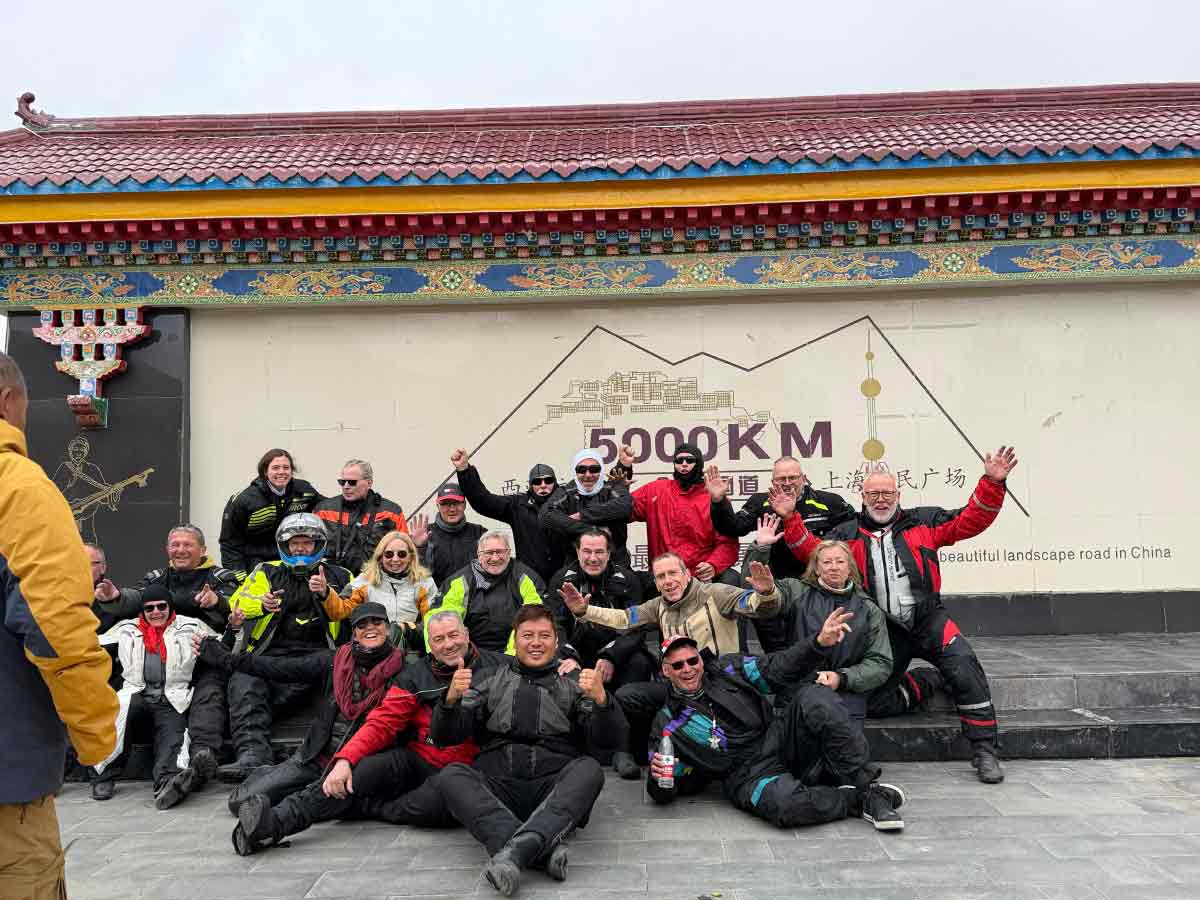
The contrast between the sacred landscapes of Kailash and the forgotten ruins of Guge is one of the defining features of the Kailash Calling journey. Few motorcycle tours anywhere in Asia combine spiritual significance, dramatic landscapes and ancient history on such a scale.
The Kailash Kora – More Than a Trek
For most riders, the motorcycle journey concludes in Ali, from where the group returns to Lhasa by domestic flight before continuing onward home. Others choose to extend the experience even further.
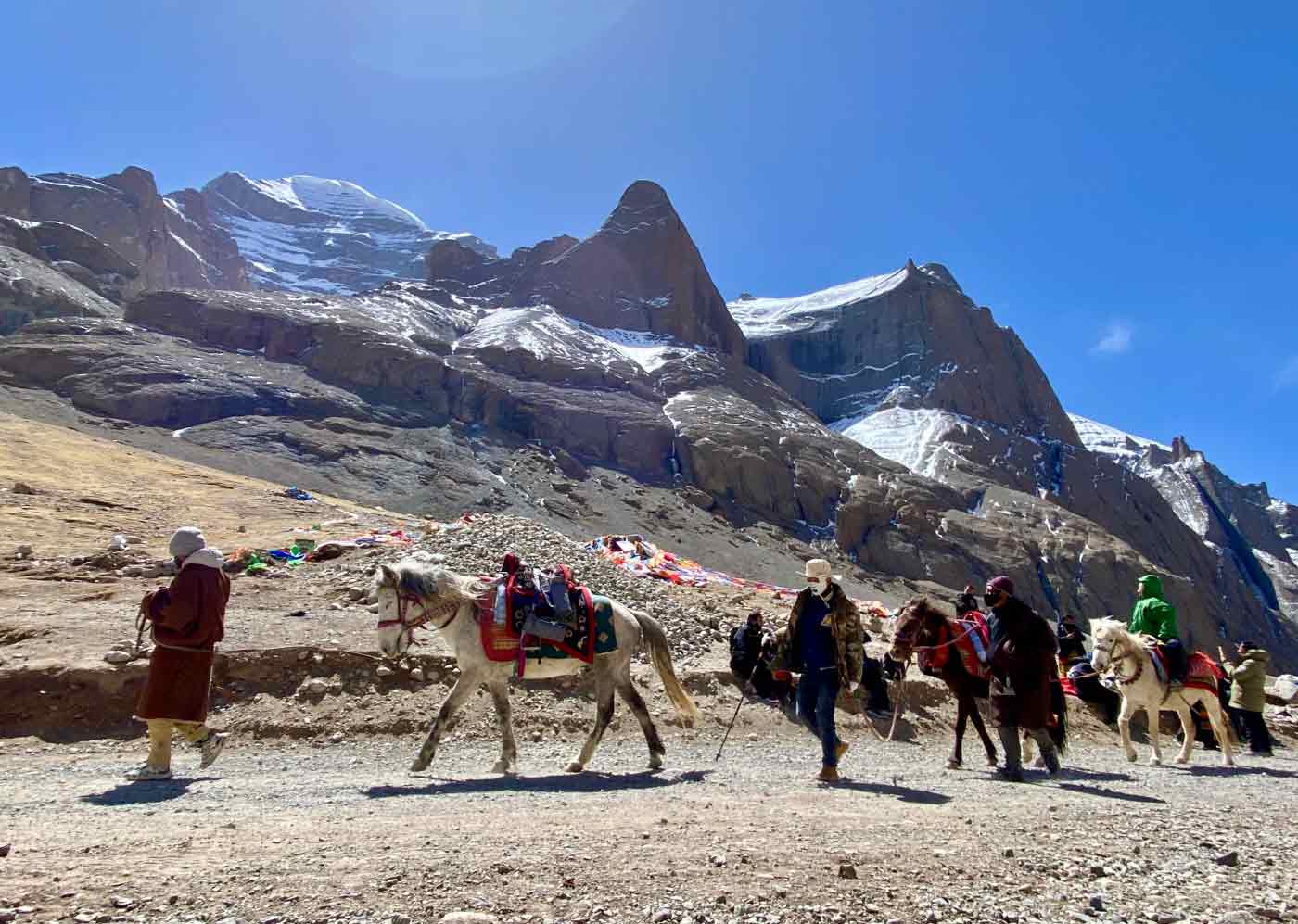
Returning to the Kailash region, they remain in Darchen to undertake the famous Kailash Kora — the sacred pilgrimage route that circles Mount Kailash and has attracted pilgrims for centuries. While the motorcycle tour itself comes to an end, the journey for these participants continues on foot through one of the most spiritually significant landscapes in the Himalaya. Once the kora begins, it becomes immediately clear that this is not a normal Himalayan trek. The trail winds through surprisingly green valleys beneath the north face of Mount Kailash, while pilgrims move steadily along the route spinning prayer wheels, chanting mantras or quietly walking in silence beneath endless blue skies. During the day, the sun at altitude can feel almost warm and gentle. But once evening arrives, temperatures drop quickly and nights become bitterly cold.
The second day of the kora is usually the most demanding. The climb towards the high pass feels endless at altitude, and weather conditions can change rapidly. Snow, icy winds and freezing temperatures are never fully impossible here, even during good seasons. And yet, once the pass is finally crossed and the descent begins, exhaustion often gives way to an overwhelming feeling of relief and achievement. Many western travellers initially compare the Mount Kailash kora to trekking in Nepal or other hiking regions of the Himalaya, but the comparison only works to a certain extent. The kora is not about mountain luxury, comfort or simply ticking off another trekking destination. It is, above all, a spiritual pilgrimage.
Accommodation during the hike itself remains very simple and is largely designed around the needs of Tibetan pilgrims rather than international trekking expectations. In many ways, this simplicity is part of the experience and has changed very little over time. Back in Darchen before and after the hike, accommodation is surprisingly comfortable considering the remoteness of western Tibet. Hotels offer proper rooms with en-suite bathrooms, and after days on the high plateau many travellers are pleasantly surprised by the standard found at nearly 4,700 metres above sea level.
At the same time, this remains one of the most remote regions in the Himalaya, where virtually everything must be transported across enormous distances over the Tibetan Plateau. Infrastructure therefore still follows its own rhythm. Sometimes the heating works perfectly. Sometimes the hot water takes a little patience before finally arriving in the shower — which, after a long day at altitude, suddenly becomes a surprisingly important moment of happiness.
But the real value of the experience lies elsewhere. It lies in the remoteness, the atmosphere, the access and the privilege of reaching one of the most sacred and isolated places on earth. The atmosphere created by hundreds — and in special years like this one, even thousands — of pilgrims moving around the mountain is difficult to describe. Prayer flags move in the wind, pilgrims chant mantras while walking the route, and every pass and valley carries a sense of spiritual significance that even non-religious visitors tend to feel.
Doing the Mount Kailash kora once in a lifetime is something that stays with people long afterwards. Not because it was easy. But because places like this have become exceptionally rare in the modern world.
A Tibet Motorcycle Journey That Stays With You
Few motorcycle journeys are as difficult to compare with ordinary travel as Kailash Calling.
- Yes, there are extraordinary roads, high mountain passes and some of the most spectacular landscapes anywhere in the Himalaya.
- Yes, there is adventure, altitude and the sense of remoteness that comes with travelling through Western Tibet.
- Yet what many riders remember most strongly are not necessarily the riding days themselves.
It is the atmosphere around Mount Kailash. The vast emptiness of the Tibetan Plateau. The warmth and hospitality of the Tibetan people. The ancient monasteries, sacred lakes and forgotten kingdoms that seem to belong to another age. And above all, it is the feeling of having reached a place that still exists largely outside the rhythm of the modern world.
For riders searching for a truly unique Tibet motorcycle tour, journeys like Kailash Calling remain among the last great overland adventures of the Himalaya.
→ Explore the full Kailash Calling Motorcycle Tour
→ Check departure dates, availability and booking information
Why Travel with TibetMoto?
As a specialist operator for motorcycle expeditions across Tibet and the Tibetan Plateau, TibetMoto has spent more than 15 years developing and refining routes across some of Asia’s most remote regions. Our deep local knowledge, long-standing regional partnerships and extensive operational experience allow us to take riders far beyond the standard tourist routes while maintaining the professional support and reliability expected from a premium expedition operator.
Why Choose a Tibet Motorcycle Expedition to Mount Kailash
- Ride across the Tibetan Plateau at altitudes above 4,000–5,000 meters
- Reach Mount Everest Base Camp from the Tibetan side
- Experience Western Tibet — one of the most remote regions in the Himalaya
- Visit the sacred Mount Kailash and Lake Manasarovar
- Explore the ancient ruins of the Guge Kingdom
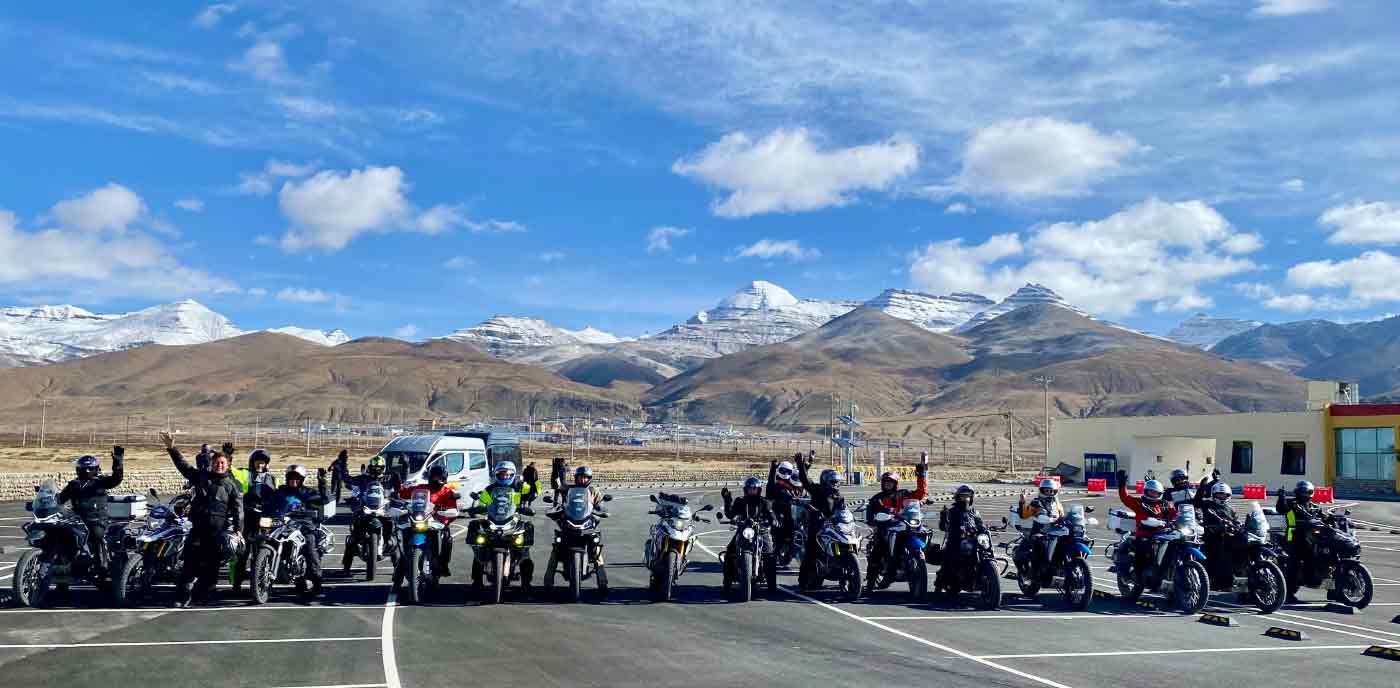
- Travel in a small, professionally supported expedition team
Expedition Notes: Kailash Calling Motorcycle Tour
The most stable riding conditions for western Tibet and Mount Kailash are usually found between mid-April and June, as well as from mid-September until mid October. During these periods, skies are often exceptionally clear and visibility across the Himalayan range can be extraordinary.
Rainy season (July till mid-September) should be avoided. Although generally warmer, rain poses a serious risk, and visibility is generally much lower.
Even during the best riding seasons, weather at altitude can change extremely quickly. Sunshine and temperatures above 20°C may turn into cold winds and under special circumstances below-freezing temperatures within only a few hours once higher passes or exposed plateau regions are reached.
Altitude:
Large parts of the expedition take place between 4,000 and 5,000 metres above sea level, with several high passes exceeding these elevations. Proper acclimatization in Lhasa is therefore an essential part of the journey and should never be underestimated. Travellers with pre-existing medical conditions should consult their doctor beforehand to discuss whether such an expedition is suitable for them and whether altitude-related medication may be advisable.
Accommodation is generally comfortable and typically in the 3*-4* range, with en-suite bathrooms available along the entire route and single rooms bookable on request. Outside central Tibet, infrastructure becomes increasingly remote and simple.
Western Tibet remains a high-altitude frontier region where occasional power cuts, limited heating or temporary infrastructure issues are simply part of everyday reality.
Conditions become more basic during the optional Mount Kailash kora hike itself, where simplicity and remoteness remain very much part of the experience.
Layered motorcycle gear suitable for almost every season within a single day is essential on the Tibetan Plateau. Conditions can shift rapidly from warm sunshine to cold winds and near-winter temperatures, especially on the higher passes. Keeping hands, feet and other extremities properly warm becomes particularly important at altitude.
Expeditions through Tibet require a certain amount of flexibility and patience. Weather, road conditions, local regulations or unforeseen circumstances can occasionally lead to route changes, delays or adjustments along the way. On the Tibetan Plateau, things do not always move according to plan — and accepting this is very much part of the experience itself.