

Trans Tibet Motorcycle Tour –
Ride to Everest Base Camp: A Bucket List Adventure
For many riders, the dream of crossing Tibet by motorcycle and reaching Everest Base Camp sits very high on the personal bucket list. It is the kind of journey that combines everything a true adventure ride should offer: high passes, vast Himalayan landscapes, ancient monasteries, Tibetan culture and the rare feeling of riding across one of the most extraordinary regions on earth.
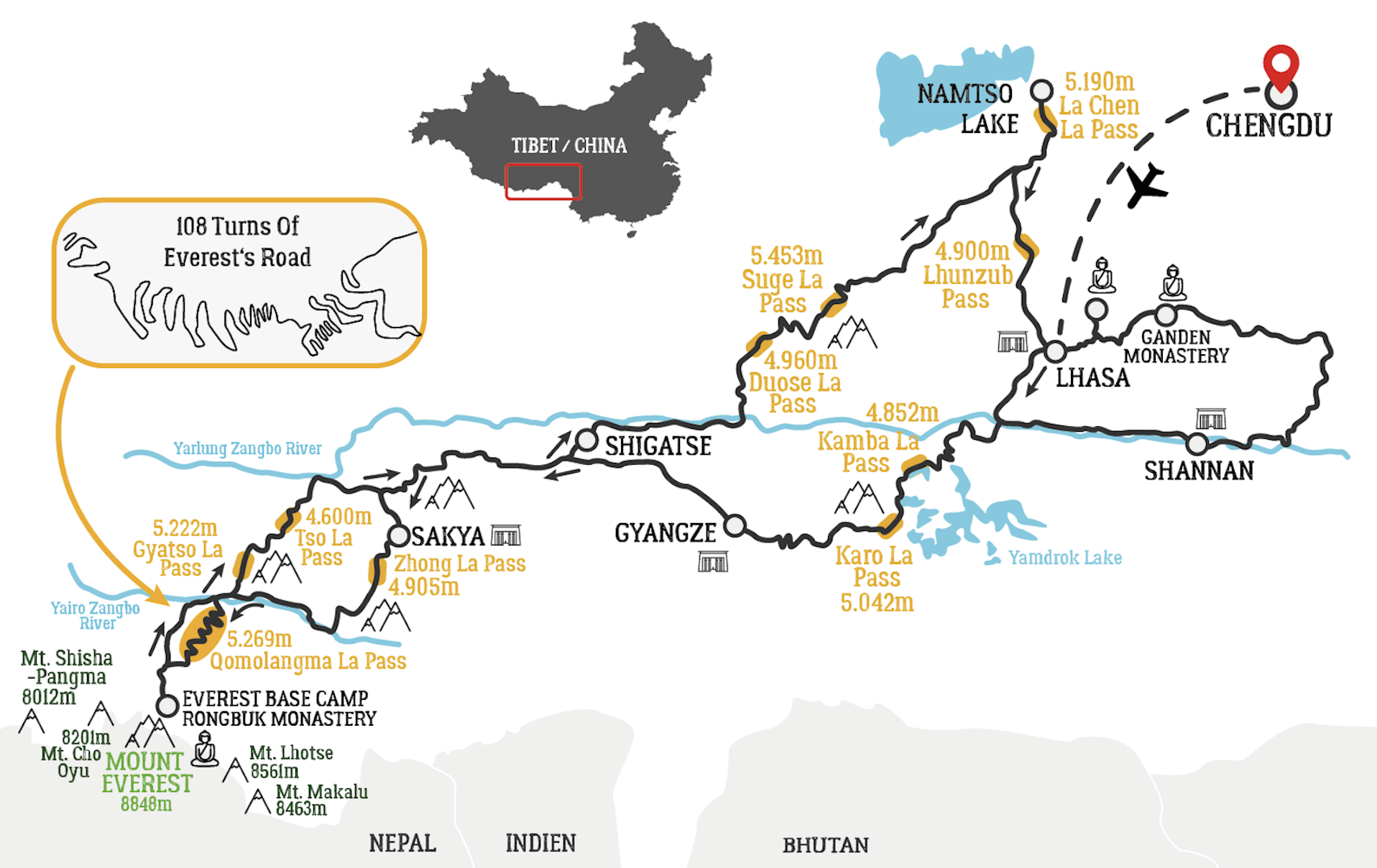
TibetMoto’s Trans Tibet ride to Everest Base Camp is not a race towards the highest mountain in the world. It is a journey that builds slowly — from the old streets and monasteries of Lhasa to sacred lakes, sweeping plateau roads and finally the great Himalayan horizon where Mount Everest rises above everything else.
A Ride Across “The Roof of the World”
From the very first days in Lhasa, the scale and atmosphere of Tibet begin to feel almost surreal. At more than 3,600 metres above sea level, Tibet’s ancient capital is far more than simply the starting point of the expedition — it is the spiritual heart of the Tibetan world.
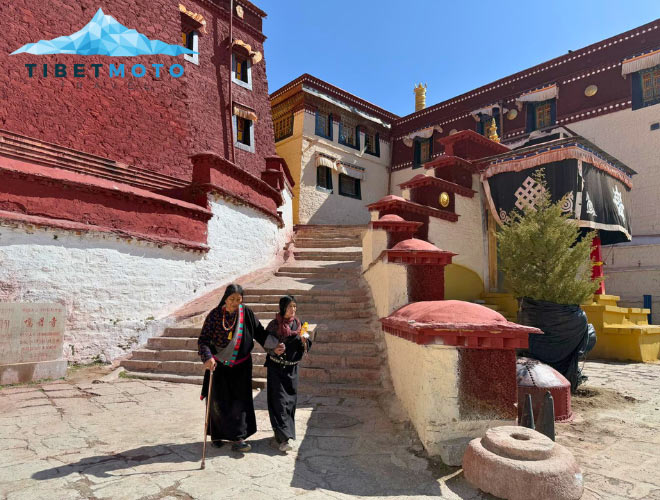
Prayer flags move in the wind above narrow old streets while the deep sound of chanting monks echoes through centuries-old monasteries. The smell of burning butter lamps drifts through the Jokhang Temple as pilgrims from all corners of Tibet slowly circle the Barkhor pilgrimage route, turning prayer wheels and bowing in devotion.
Imagine standing in the middle of all of this, while your motorcycle waits at the hotel in the streets of Lhasa — already realising that this journey is becoming a very special motorcycle tour. Before the engines turn west toward Everest, you will explore landmarks such as the Potala Palace — the former residence of the Dalai Lama — as well as the Jokhang Temple, Barkhor Market and the famous Sera Monastery, where animated debates between red-robed monks still bring ancient Buddhist philosophy to life every afternoon.
These first days in Lhasa are not only an introduction to Tibetan culture, but also the natural beginning of the acclimatisation process before the expedition climbs higher onto the Tibetan Plateau and toward Mount Everest Base Camp.
Setting Out: Lakes, Fortresses and High Passes
The real feeling of the expedition begins the moment the motorcycles finally leave Lhasa behind.
Traffic slowly fades away, the city disappears in the mirrors, and the road begins to follow the broad valley of the Yarlung Tsangpo River — one of Tibet’s great lifelines. The air is still relatively mild, the sky impossibly blue, and after days in Lhasa there is suddenly that familiar feeling every rider knows: the journey is finally underway.
One of the first major stops is Yumbulakhang, often considered the oldest fortress in Tibet. Rising high above the valley on a narrow ridge, the castle looks almost unreal against the surrounding mountains and wide-open landscapes. Long before Tibet became associated with monasteries and Buddhism, this was already a place of kings, legends and early Tibetan history. From there, the expedition continues toward Samye Monastery — the first Buddhist monastery ever built in Tibet — before the road begins climbing steadily higher into the mountains. And then the landscape suddenly opens up.
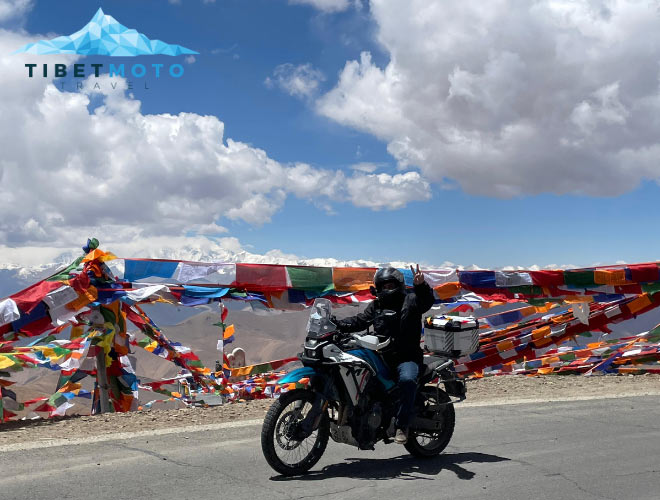
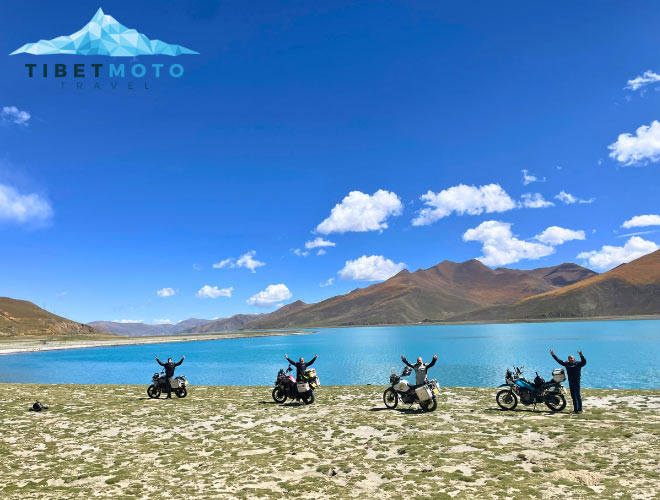
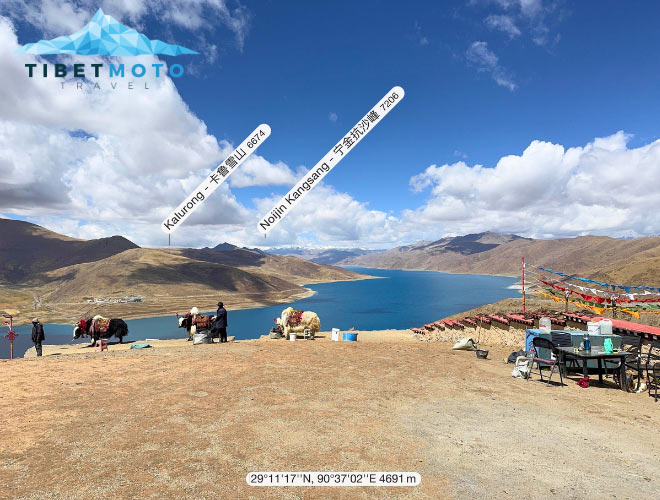
After endless sweeping curves over the Kamba-La Pass, the turquoise waters of Yamdrok Lake appear far below the road, framed by snow-covered peaks and prayer flags moving violently in the wind. Even riders who have travelled extensively through the Himalayas are often caught off guard by the scale and colour of the lake.
Local legend says the sacred waters can cleanse sins. In theory, anyone looking for a complete spiritual reset is welcome to jump into the freezing water. However, most riders decide that admiring the lake from the roadside is already spiritual enough. And certainly much warmer!
As the expedition pushes further west, the altitude becomes increasingly noticeable. The road climbs higher toward the Karola Glacier, where massive walls of ice suddenly appear directly above the asphalt at more than 5,000 metres above sea level. The air grows thinner, the temperatures cooler, and the landscapes begin changing into the vast open plateau scenery that defines motorcycle travel across Tibet.
From here the ride continues across high passes and wide Himalayan valleys toward Gyantse, home to the famous Palcho Monastery and the extraordinary Kumbum Stupa — one of the architectural masterpieces of Tibet.
And at this point, riders slowly begin to realise that this journey is not only about reaching Everest Base Camp. It is about the feeling of crossing Tibet itself.
The Road of 108 Curves to Mount Everest
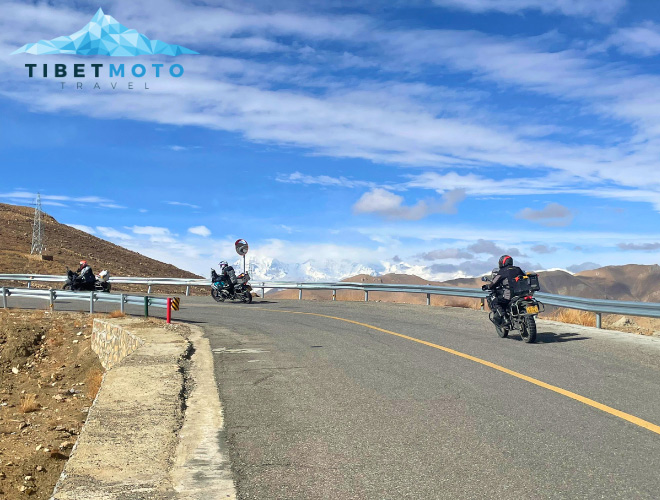
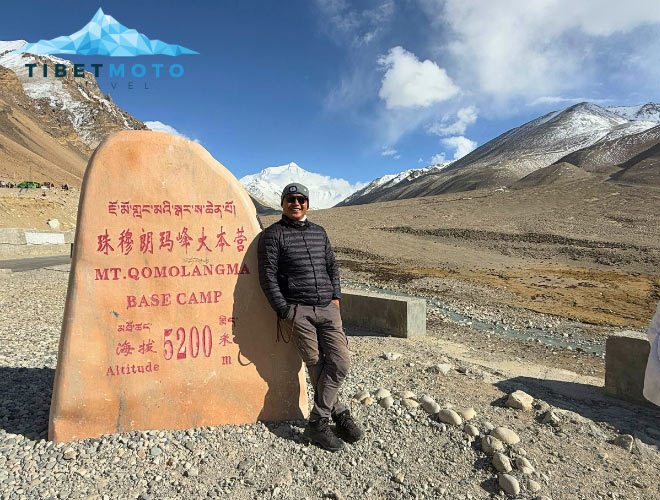
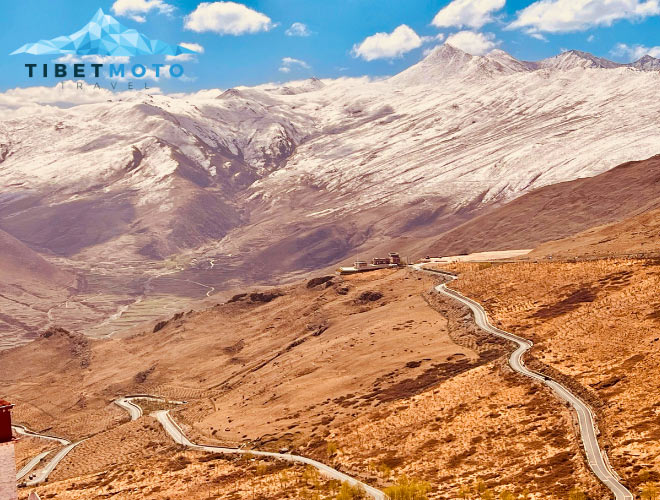
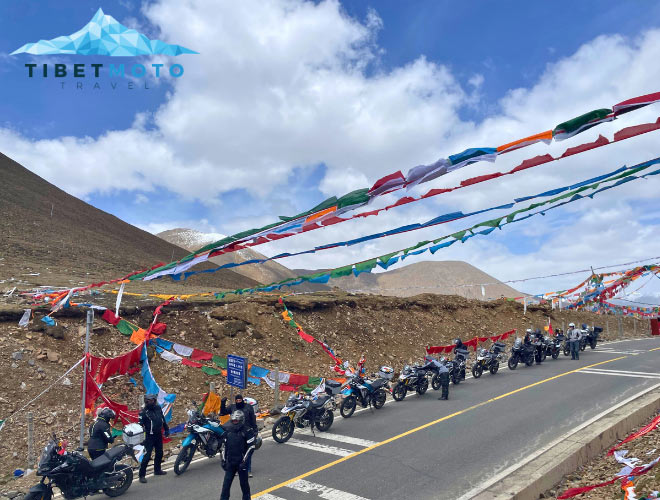
The closer we ride toward Everest, the more dramatic the landscape becomes. Beyond Tingri, the Tibetan Plateau begins to rise once again toward the Himalaya, and eventually the road reaches one of the most famous viewpoints in all of Tibet. At more than 5,200 metres above sea level, the world suddenly seems to open in every direction. And then the descent begins. Far below the pass, the legendary road of 108 curves twists its way toward Mount Everest Base Camp — a seemingly endless chain of switchbacks dropping down through the barren high-altitude landscape. For many riders, this is one of the defining motorcycle roads of the entire Himalaya.
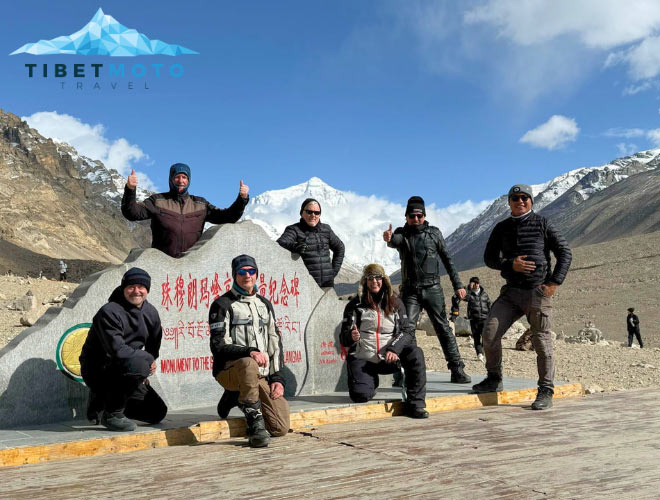
But it is not only the road itself that makes this moment unforgettable. Directly ahead rises Mount Everest at 8,848 metres, dominating the horizon with an almost unreal scale. To one side stands Cho Oyu, elegant and massive at 8,188 metres. Further along the Himalayan wall appear Lhotse and Shishapangma, while countless unnamed snow-covered peaks stretch endlessly across the skyline of the Tibetan Plateau. Looking across this landscape, it is hard not to wonder how many great mountaineering stories, exploration journeys and personal dreams have unfolded among these mountains over the decades.
The air feels thinner here. The wind colder. Every curve reveals another angle of the Himalaya. Every few kilometres, the sheer scale of the landscape almost forces you to slow down again and simply take it all in. Somewhere along these endless switchbacks, it is no longer simply about reaching Everest, but about fully experiencing the vastness of Tibet and the Himalaya themselves.
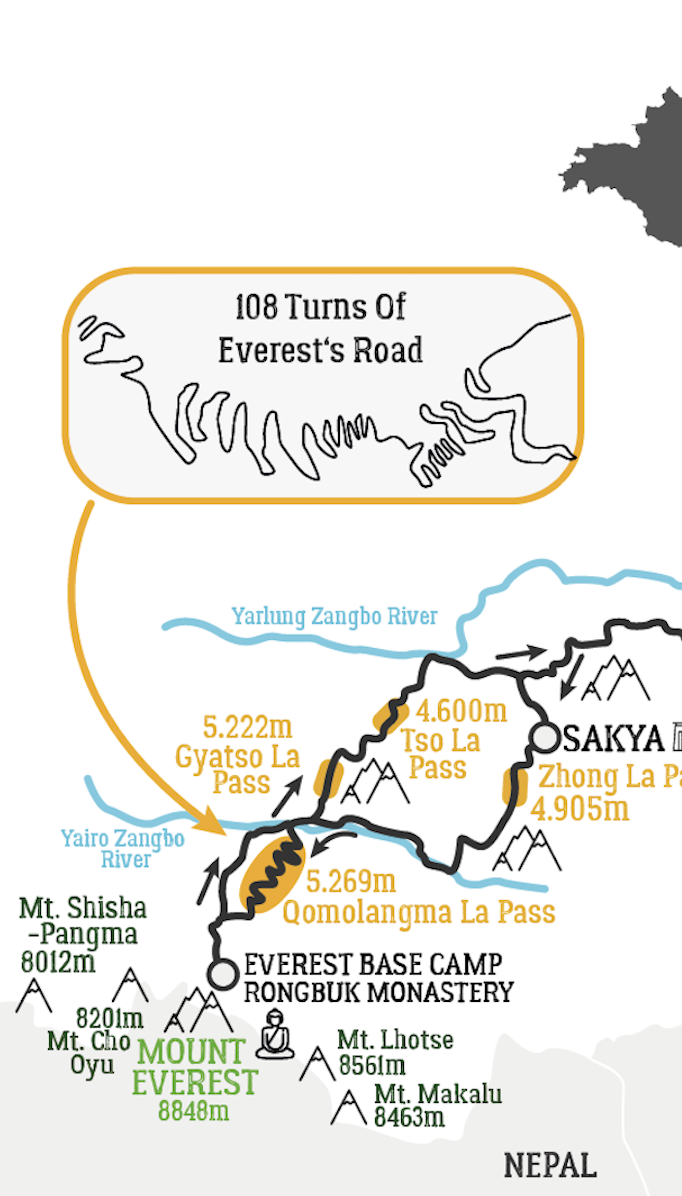
This legendary section is one of the highlights of our Trans Tibet Motorcycle Tour
Arrival at Rongbuk Monastery
Eventually the road reaches the final settlement before Mount Everest Base Camp. This is where the motorcycles have to stay behind.
In recent years, private vehicles have no longer been permitted to continue all the way to Rongbuk and Everest Base Camp in order to protect the fragile high-altitude environment surrounding the mountain. After days of crossing Tibet by motorcycle, it feels slightly strange to suddenly leave the bikes standing on the plateau while the journey continues by shuttle bus across the final barren kilometres toward Everest. But the moment the north face of Mount Everest begins growing larger through the dust and cold Himalayan wind, nobody thinks much about the motorcycles anymore.
The scale of the mountain simply takes over. At nearly 5,000 metres above sea level lies Rongbuk Monastery — the highest monastery in the world and one of the most extraordinary overnight stops anywhere in the Himalaya. Accommodation here remains simple and deeply Tibetan in character, but that is precisely what gives the place its atmosphere. As evening approaches, the summit of Everest slowly changes colour in the fading light, shifting between gold, orange and deep pink. And once darkness finally arrives, the silence becomes almost complete. On clear nights, the Milky Way stretches across the sky above Everest with a clarity few places on earth still offer.
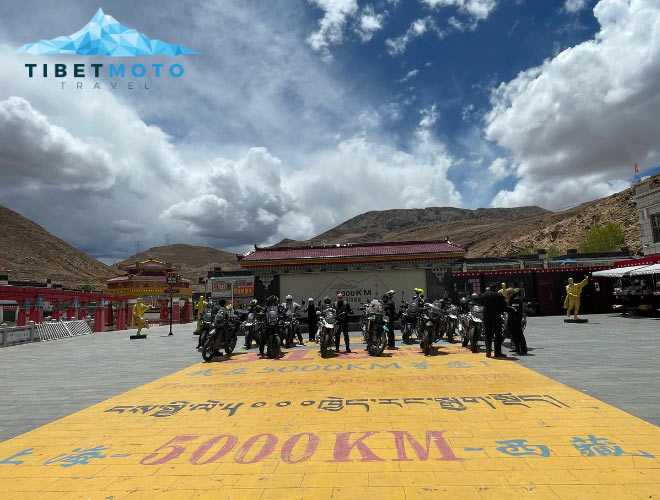
Beyond Everest: Remote Passes, Grasslands and Sacred Lakes
After the long riding days around Everest Base Camp, Shigatse offers a welcome chance to slow the pace for a moment. Beneath the old fortress overlooking the town, narrow streets, lively Tibetan markets and small restaurants create a noticeably different atmosphere again after the silence and vastness of the high plateau.
Just outside the city rises Tashilhunpo Monastery — the traditional seat of the Panchen Lama and one of the largest and most important monasteries in Tibet. Golden roofs shine above massive monastery walls while monks move quietly through incense-filled courtyards lit by countless burning butter lamps. For many participants, this two nights stay in Shigatse becomes an important transition before the expedition pushes once again into the remote northern reaches of the Tibetan Plateau.
Leaving Shigatse behind, the road gradually climbs back into increasingly vast and isolated landscapes. The expedition crosses remote Himalayan passes such as Suge La (5,450 m), Tso La (5,250 m) and La Chen La (5,150 m), where the scale of the plateau begins to feel almost endless again.
Long ribbons of asphalt disappear toward the horizon while rivers, snow-covered ridgelines and enormous open valleys dominate the scenery. Traffic becomes rare, settlements increasingly small and distant, and the feeling of travelling through one of the most remote regions in Asia steadily returns.
And then, slowly, the landscape begins to soften again. After days surrounded by barren high-altitude terrain, greener valleys suddenly begin to appear beyond the passes. Small Tibetan villages emerge between rolling hills, wheat fields move in the wind beside the road, and herds of yaks graze quietly across the grasslands. Depending on the season, nomadic families can often be seen moving through the region with tents, horses and livestock — a way of life that has existed on the Tibetan Plateau for centuries.
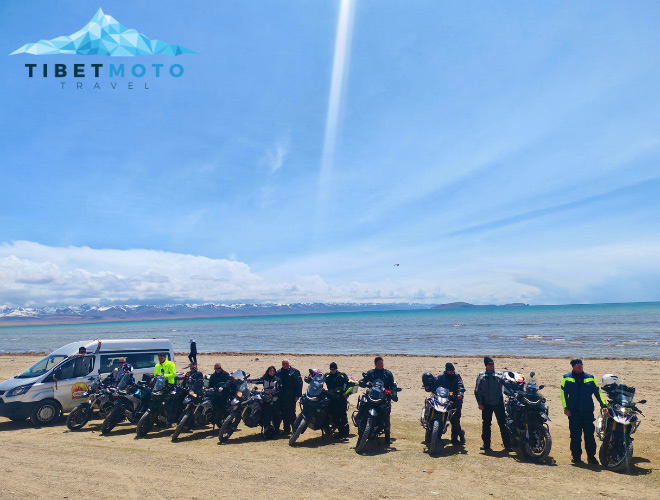
From there the road continues toward one of the great natural highlights of Tibet: Namtso Lake.
At more than 4,700 metres above sea level, the sacred lake stretches endlessly beneath snow-covered mountains and enormous Tibetan skies. Prayer flags whip violently in the plateau wind while the deep blue water changes colour constantly depending on the light and weather conditions.
By the time the motorcycles finally roll back into Lhasa, the great circle across Tibet has been completed. What remains are not only photographs of Everest, high passes and sacred lakes, but also the feeling of having crossed one of the last truly great adventures in the Himalaya — a journey that stays with you long after the engines have fallen silent.
Contact us for tour dates, availability and further information about the next Trans Tibet Motorcycle Tour to Everest Base Camp.